Politics in the Gambia and Guinea-Bissau: Precolonial Influence on the Postcolonial State by Mariama Khan
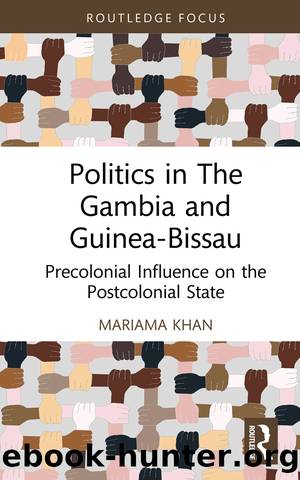
Author:Mariama Khan [Khan, Mariama]
Language: eng
Format: epub
Tags: African, Developing & Emerging Countries, Social Science, Political Science, World
ISBN: 9781000539462
Google: _vJMEAAAQBAJ
Goodreads: 58890415
Publisher: Routledge
Published: 2021-11-18T12:33:33+00:00
The rise and fall of Janky Wally
Mama Janky Wally was born in Kapbintun in the Wassa Kunda clan in the region of Pachana. People from the clan maintained their traditional authority even in the postcolonial context and are the traditional leaders of Kapbintun. Janky Wallyâs father is given a secondary role in oral traditions, unlike his mother, Kumencho. His future prospects for becoming mansa was discovered from an early age. His parents sent him away on a smith apprenticeship. This journey was part of Mandinka cultural appreciation for self-imposed or forced exile, which was considered an experience that built the individualâs character, instilled empathy, an important attribute of leadership, and demonstrated the true character of an individual, which could better be appreciated during hardships. They believed how a person conducts him/herself during hardships in the wilderness was a good measure of their potential to be a good leader.
While away, Janky Wally adopted the pseudonym Numunding (little smith) Janbang (a family name) to disguise his royal origins. He returned home after he mastered his smith trade and came of age. He started his smith practice and was well respected for his skills.
Jally Wally was the royal jali that visited him to inform him about his nomination for the Kaabu mansa position. The former was one of the functionaries who presided over the latterâs leadership endurance tests. While on the third royal birth, blood exuded from the shrine, a warning of the blood that would be spilt under Janky Wallyâs rule.
While on their journey to the installation ground, Jally Wally cut a branch of the Sibikarangho tree and tied it to his left hand, to imply he must unite Kaabu. It also alluded to the harsh political encounters that awaited him. Traditionally, Sibikarangho had multiple purposes in Manding society. It was used for the construction of the roofs of houses, in fencing or as rope. Thus, Janky Wally became inducted into official Kabunka power. The daal was the next and final ritual he needed to perform, before Jally Wally, the king-makers and Kaabu, to disclose his political vision and what he would achieve for his people.
Janky Wallyâs first act was to violate the mansa dress code. At his request, his wife Kumba Sambangho brought him a traditional lappa, which he wore in place of pants, before sitting on the royal hearth. Stunned, Jally Wally asked him on behalf of the elders and Kaabu why he had done that. He replied that all the 11 mansas before him wore pants to the hearth. But no pant-wearing mansa would inherit Kaabuâs throne after him. The wearing of the lappa signified he was the last warrior mansa of Kaabu. The jalis who were present named him âour mansa who does not wear pants.â Janky Wally got up, faced the people, raised his hands up, and declared:
I hereby place all Kaabu in the palm of my right hand and I place it on my shoulder. If my palm does not break, and my shoulder does not
Download
This site does not store any files on its server. We only index and link to content provided by other sites. Please contact the content providers to delete copyright contents if any and email us, we'll remove relevant links or contents immediately.
| Anthropology | Archaeology |
| Philosophy | Politics & Government |
| Social Sciences | Sociology |
| Women's Studies |
The Secret History by Donna Tartt(19088)
The Social Justice Warrior Handbook by Lisa De Pasquale(12190)
Thirteen Reasons Why by Jay Asher(8910)
This Is How You Lose Her by Junot Diaz(6887)
Weapons of Math Destruction by Cathy O'Neil(6280)
Zero to One by Peter Thiel(5802)
Beartown by Fredrik Backman(5754)
The Myth of the Strong Leader by Archie Brown(5508)
The Fire Next Time by James Baldwin(5446)
How Democracies Die by Steven Levitsky & Daniel Ziblatt(5219)
Promise Me, Dad by Joe Biden(5153)
Stone's Rules by Roger Stone(5088)
A Higher Loyalty: Truth, Lies, and Leadership by James Comey(4964)
100 Deadly Skills by Clint Emerson(4925)
Rise and Kill First by Ronen Bergman(4789)
Secrecy World by Jake Bernstein(4753)
The David Icke Guide to the Global Conspiracy (and how to end it) by David Icke(4720)
The Farm by Tom Rob Smith(4513)
The Doomsday Machine by Daniel Ellsberg(4490)
